
The case of Myon Burrell, a Black teenager convicted of the 2002 murder of 11-year-old Tyesha Edwards in Hennepin County, Minnesota, has emerged as a focal point for critiques of prosecutorial misconduct and political opportunism. Under the leadership of then-County Attorney Amy Klobuchar, the prosecution secured a life sentence for Burrell despite a total lack of physical evidence, reliance on unreliable jailhouse informants, and the systematic suppression of exculpatory statements from co-defendants.
While Klobuchar leveraged the conviction for nearly 17 years to bolster her “tough-on-crime” credentials and political ambitions, a 2020 Associated Press investigation exposed deep procedural and evidentiary flaws. The case highlights broader systemic issues, including the use of coercive interrogation tactics on juveniles, the deployment of inflammatory “gang expert” testimony, and the prioritization of convictions over factual accuracy.
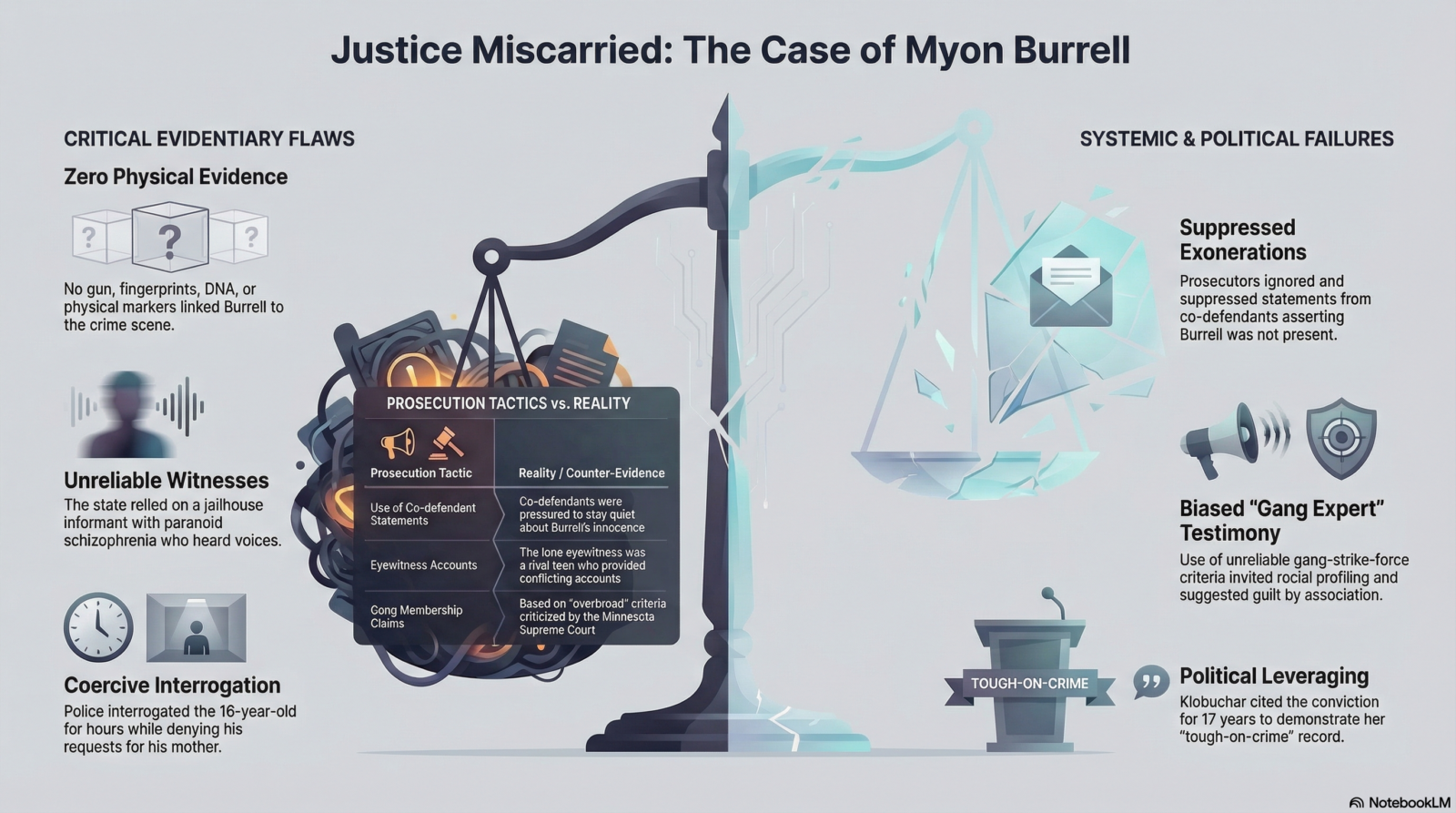
Case Overview: The Murder of Tyesha Edwards
In 2002, 11-year-old Tyesha Edwards was killed by a stray bullet while doing homework at her dining room table. Police and prosecutors alleged that 16-year-old Myon Burrell fired the shot while aiming at a gang rival.
The prosecution of Burrell took place against a backdrop of public panic regarding gang violence and the “super predator” myth. As a candidate for county attorney, Amy Klobuchar pledged a “swift” response to juvenile crime to “send a tough message.” Burrell was convicted of first-degree murder in 2003 and sentenced to life in prison.
The Role of Amy Klobuchar
For over a decade and a half, Amy Klobuchar cited the Burrell conviction as a major achievement in her career, using it to demonstrate her commitment to racial justice and public safety.
- Political Asset: Klobuchar highlighted the case in speeches, interviews, and primary debates to prove her “tough-on-crime” efficacy. In 2006, the victim’s mother appeared in a campaign ad for Klobuchar’s Senate run, praising her for putting “those gang members away.”
- Response to Scrutiny: Following the 2020 AP investigation, Klobuchar distanced herself from the case, claiming she was unaware of “new evidence.” However, critics note that much of the evidence of innocence was available or intentionally suppressed during her tenure.
- Commitment to Re-prosecution: After the Minnesota Supreme Court reversed Burrell’s first conviction in 2005, Klobuchar publicly vowed to “move forward and bring justice—again,” ensuring a second trial proceeded.
Evidentiary Flaws and Investigative Failures
The case against Burrell was built on a foundation of questionable tactics and a lack of corroborating physical data.
Absence of Physical Evidence
- Murder Weapon: Never recovered.
- Fingerprints: None linking Burrell to the crime.
- DNA: No physical DNA evidence found.
- Gunshot Residue: No physical evidence linking Burrell to the shooting.
Coercive Interrogation
Police interrogated the 16-year-old Burrell for hours. During this process, investigators:
Refused Burrell’s repeated requests to speak with his mother.
Lied to the suspect about the evidence they had gathered.
The Minnesota Supreme Court eventually ruled these tactics coercive, finding that Burrell had not voluntarily agreed to speak, rendering the interrogation video inadmissible.
Unreliable Witnesses
The prosecution relied on a lone eyewitness—a teenage rival of Burrell—who provided conflicting accounts. Additionally, the state used James Turner, a jailhouse informant with paranoid schizophrenia who claimed to hear voices, to testify that Burrell confessed while in custody. A forensic psychiatrist’s testimony that Turner was being “truthful” was later labeled “improper” and “prejudicial” by the state Supreme Court.
Suppression of Exculpatory Evidence
The prosecution actively worked to prevent the jury from hearing evidence that suggested Burrell’s innocence, particularly regarding his co-defendants, Ike Tyson and Hans Williams.
Co-defendant Statements: Shortly after the shooting, Tyson admitted to being the shooter to friends, inmates, and his attorney, explicitly stating Burrell was not present. Williams similarly informed his attorney of Burrell’s innocence.
Manipulated Plea Deals: The state Supreme Court found it “suspicious” that the state conditioned Tyson’s plea deal on his agreement not to testify about his prior statements exonerating Burrell.
Misleading the Jury: Rather than allowing cross-examination of the co-defendants, prosecutors showed jurors an interrogation video where police mischaracterized the co-defendants’ statements to make it appear as though they had blamed Burrell.
Use of Inflammatory “Gang Expert” Testimony
The prosecution employed an officer from the Minnesota Gang Strike Force to testify about Burrell’s “purported gang affiliation” using a controversial 10-point criteria.
Critique of Methodology: Legal experts and the Minnesota Supreme Court have criticized such “expert” testimony as being based on inadmissible hearsay and skewed observations rather than a generally accepted body of knowledge.
Racial Profiling: Critics argue these criteria are overbroad and serve as a “license to control youths” without articulable suspicion, effectively inviting racial profiling and suggesting guilt by association.
Judicial Reversal and the Second Trial
In 2005, the Minnesota Supreme Court reversed Burrell’s first conviction, citing the inadmissible interrogation video and the “improper” testimony regarding the jailhouse informant.
Despite this, a second trial was held in 2008 under Hennepin County Attorney Mike Freeman (who succeeded Klobuchar). Before the trial, the state unsuccessfully attempted to remove the presiding judge, who reportedly believed the evidence was insufficient. In the second trial:
- Burrell was tried before a judge rather than a jury.
- Ike Tyson testified under oath that he, not Burrell, was the shooter.
- Hans Williams testified that Burrell was not at the scene.
- The judge convicted Burrell regardless of this testimony.
Conclusion
The conviction of Myon Burrell stands as a significant example of the “conviction at any cost” mentality. The record indicates that the Hennepin County Attorney’s office, under Amy Klobuchar, prioritized political messaging and “tough-on-crime” optics over the investigation of alibis and the disclosure of exculpatory evidence. Today, the case serves as a catalyst for the increased scrutiny of prosecutors and their roles in driving mass incarceration and racial disparities within the legal system.
REFERENCE: https://theappeal.org/amy-klobuchar-myon-burrell/