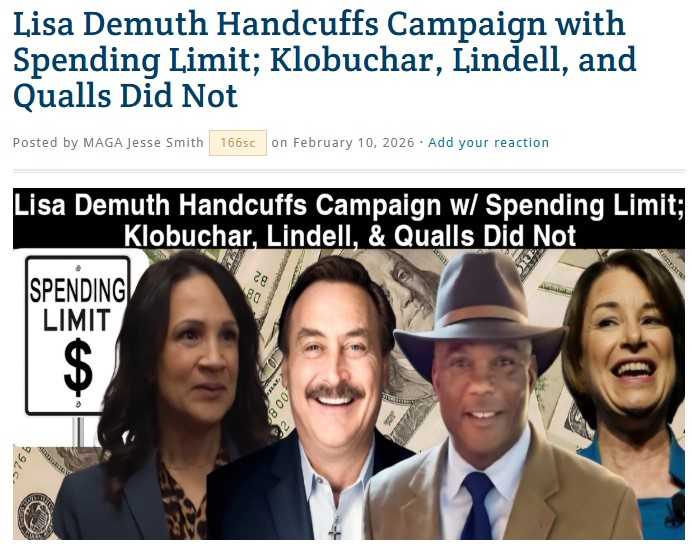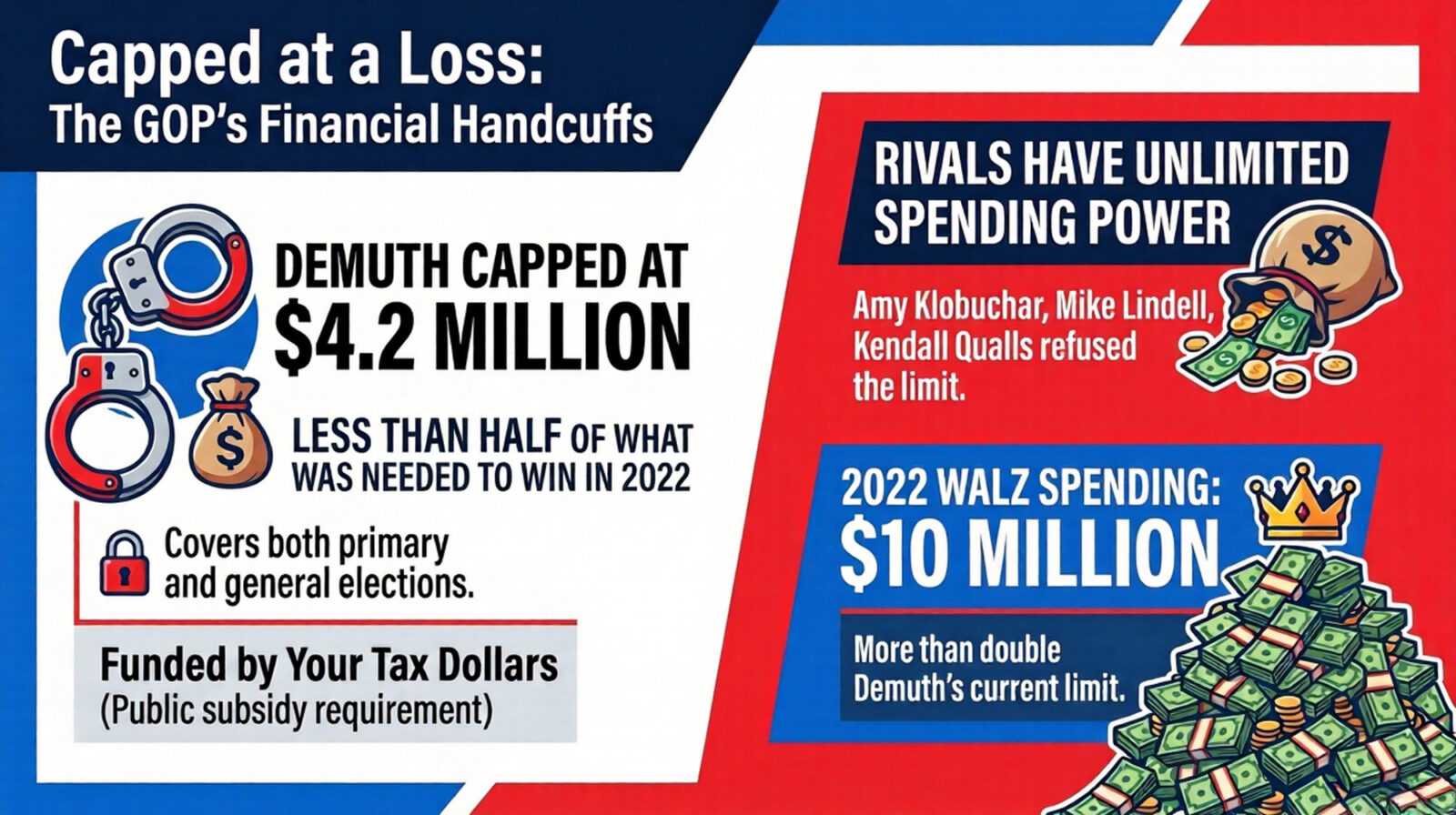
The 2026 Minnesota gubernatorial race is defined by a significant financial divide between the candidates, primarily driven by participation in the state’s public subsidy agreement. Lisa Demuth, a Republican candidate, has signed a public subsidy agreement that caps her total campaign spending for both the primary and general elections at approximately $4.2 million. This decision has drawn criticism for potentially “handcuffing” the Republican effort against the Democratic Party’s substantial financial resources.
In contrast, Democratic opponent Amy Klobuchar and Republican challengers Mike Lindell and Kendall Qualls have refused the spending limits, allowing them to raise and spend unlimited funds. Historical data suggests this creates a massive disparity; for example, Governor Tim Walz spent nearly $10 million in 2022 to retain his seat. Critics argue that Demuth’s participation in the subsidy program, combined with her reliance on lobbyist and PAC funding rather than small-dollar donors, places the Republican party at a strategic disadvantage heading into the general election.
The Public Subsidy Agreement and Spending Constraints
The Minnesota public subsidy agreement is an optional program where candidates receive taxpayer-funded subsidies for their campaigns in exchange for adhering to a strict spending limit.
Financial Mechanics of the Agreement
- Taxpayer Funding: In 2024, the Campaign Finance Board (CFB) distributed over $2 million in tax dollars to candidates, with over $1.2 million going to Democrats and over $860,000 to Republicans.
- Historical Payouts (2022):
- Scott Jensen: Received over $500,000.
- Keith Ellison: Received over $146,000.
- Kim Crockett: Received over $66,000.
- Julie Blaha: Received over $55,000.
- Demuth’s Cap: By signing the agreement, Lisa Demuth is limited to a total expenditure of roughly $4.2 million for the entirety of the primary and general election cycles.
Impact of Early Spending
The $4.2 million cap is cumulative. Funds spent early in the campaign cycle—such as the television commercials Demuth has already aired for the caucus—are deducted from the total allowable amount for the general election. This reduces the financial reserves available to challenge a Democratic opponent in the final stages of the race.
Comparative Candidate Financial Strategies
The field for the 2026 gubernatorial race is split between those adhering to state-mandated limits and those pursuing an uncapped fundraising strategy.
Candidate | Party | Spending Limit | Subsidy Status |
Lisa Demuth | Republican | ~$4.2 Million | Accepted |
Amy Klobuchar | Democrat | Unlimited | Refused |
Mike Lindell | Republican | Unlimited | Refused |
Kendall Qualls | Republican | Unlimited | Refused |
John Krhin | Republican | Unlimited | Refused |
The Democratic Financial Advantage
The Democratic Party is described as a “financial powerhouse” that has outpaced Republican fundraising for decades. In 2022, Governor Walz spent nearly $10 million—more than double Demuth’s current $4.2 million cap. Current reports indicate that the reserves held by Klobuchar, Walz, and the MN Democrat Party already exceed the total amount Demuth is legally permitted to spend.
Republican Internal Divergence
The decision to accept the subsidy is a point of contention within the Republican primary:
- Lindell and Qualls: By refusing the subsidy, these candidates maintain the ability to match Democratic spending dollar-for-dollar.
- Ryan Wilson: Demuth’s running mate previously refused the public subsidy agreement during his 2022 run for Auditor, leading to questions regarding the shift in strategy for the higher-stakes gubernatorial race.
Donor Profiles and Grassroots Support
The source of campaign funds is emerging as a critical metric for evaluating candidate viability and “grassroots” appeal.
- Lisa Demuth: Analysis of 2025 filings indicates that Demuth has raised more significant sums from lobbyists and Political Action Committees (PACs) than from small-dollar donors.
- Mike Lindell: The majority of Lindell’s financial support is derived from small-dollar, grassroots donors. Notably, a significant portion of these donations comes from out-of-state supporters, a factor identified as necessary for Republicans to compete with the established Democratic “machine.”
Strategic Conclusions and Political Outlook
The current financial trajectory of the Lisa Demuth campaign suggests a difficult path to victory in a general election against a Democratic incumbent or well-funded challenger.
- Guaranteed Disadvantage: By capping her spending at $4.2 million, Demuth may be unable to financially compete with Klobuchar, who has no limit.
- Primary Volatility: Despite leading in a recent caucus straw poll, Demuth failed to secure even a third of the total vote, suggesting the Republican nomination remains highly contested.
- Ideological Opposition: Critics characterize the public subsidy program as a “Socialist” mechanism that forces taxpayers to fund “crony politicians.” The decision to participate in this program is viewed by some as a betrayal of conservative principles and a strategic error that “handcuffs” the GOP’s ability to win the Governorship in 2026.
See Related Story